

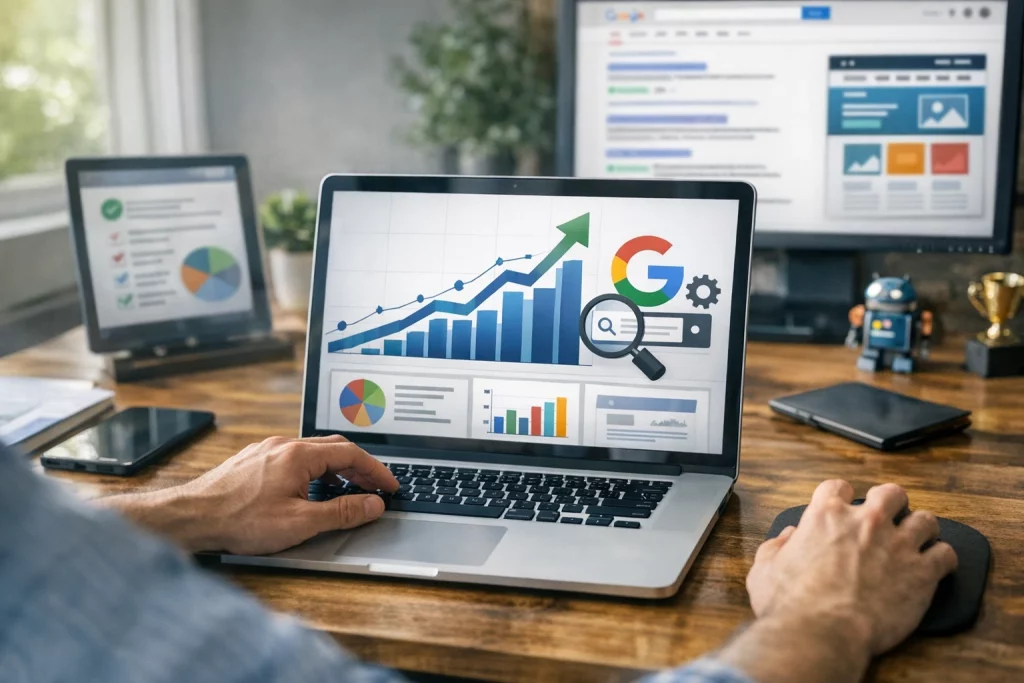
If you want Google to reward your site in 2026, your design can’t just look good — it has to perform and prove authority across devices. You’ll need fast Core Web Essentials, clear content hierarchy, mobile-first layouts, and structured data to make crawling and ranking straightforward. There are specific UX patterns and media optimizations that move the needle, and a safe testing plan to deploy them — here’s where to start.
How SEO-Friendly Web Design Affects Rankings : Core Impact + 7-Point Checklist
Because Google’s goal is to surface the most useful pages, your site’s design directly affects rankings: better UX lowers bounce rates and boosts engagement, which search signals reward.
You’ll see SEO-friendly web design improve Google rankings by focusing on user experience and measurable ranking factors. Prioritize Core Web Essentials and page speed so visitors stay and convert.
Use responsive layouts for mobile-first indexing and semantic HTML so search engines understand content hierarchy. Keep an organized website structure with clear navigation and internal links to distribute authority and guide users.
Regularly audit performance and update links, templates, and content.
Checklist:
1) fast page speed,
2) LCP within 2.5s,
3) responsive design,
4) semantic markup,
5) tidy navigation,
6) internal links,
7) routine audits.
SEO-Friendly Web Design: Crawlability, Mobile-First & Core Web Vitals
When you design for crawlability, mobile-first users, and Core Web Essentials together, you give Google the signals it needs to index, rank, and surface your pages more often.
Start with clean XML sitemaps and robots.txt, responsive layouts, and fast, stable pages so both bots and visitors get a clear, quick path to your content. You’ll boost SEO-friendly web design by combining technical SEO with user-centered choices: guarantee semantic HTML, implement structured data, and optimize loading times.
Mobile-first design matters because search engines prioritize mobile content and most users browse on phones. Core Web Vitals (LCP, FID, CLS) measure real user experience and directly affect Google rankings, so monitor and improve them continuously.
- Prioritize crawlability: sitemaps, robots.txt, logical URLs
- Optimize for mobile-first design and fast loading times
- Fix Core Web Vitals: reduce LCP, improve interactivity, prevent layout shifts
Structure Content & Navigation to Prove Topic Authority
If you organize your site with clear navigation, logical headings, and purposeful internal links, you prove to both users and search engines that you’re an authority on the topic.
You should structure content with a clear hierarchy (H1, H2, H3) so visitors and crawlers see relationships between pages, improving user experience and reducing bounce rates.
Use internal linking to connect related articles, signaling depth and strengthening site authority while aiding discoverability.
Implement semantic HTML and XML sitemaps so search engines accurately interpret context and index important pages.
Treat navigation as part of your SEO strategy: a well-organized website speeds crawling, increases time on site, and boosts Google rankings.
Consistent structure, links, and markup collectively reinforce topic authority.
Design UX Patterns That Boost Engagement, Trust & EEAT
Although subtle design choices often go unnoticed, they play a big role in boosting engagement, trust, and E‑E‑A‑T by guiding users smoothly through your content, signaling credibility, and encouraging interaction.
You should deploy design ux patterns that prioritize intuitive navigation and mobile-first design to improve user experience and lower bounce rates, which lifts engagement metrics and Google rankings.
Consistent branding and clear calls to action create trust signals that reinforce E‑E‑A‑T and familiarity across pages.
Regularly test responsive design, site speed, and usability as part of website optimization to maintain satisfaction and authority.
- Use predictable layouts and clear CTAs to guide behavior.
- Keep branding consistent to build trust and expertise.
- Prioritize mobile workflows and responsive design for better rankings.
Optimize Images & Video (Including YouTube) for SEO and Speed
Good visual design guides users toward action, but your images and video carry the dual job of persuading humans and signaling relevance to search engines—so you should optimize them for both SEO and speed.
You should use descriptive file names and clear alt text to boost accessibility and SEO performance, making content understandable to crawlers.
Focus on compressing images to lower file sizes without visible quality loss, because large files hurt page load speed.
Implement responsive images to serve appropriate resolutions per device, improving UX and load times.
For video content, optimize titles, descriptions, tags, and thumbnails to raise YouTube SEO and drive traffic back to your site.
Better thumbnails increase click-through rates, so test visuals that communicate value quickly and clearly.
A/B Test and Roll Out Design Changes Safely: Metrics, QA, Rollback
When you roll out design changes, run A/B tests to measure real user impact on click-throughs, bounce rate, and session duration so you can make data-driven decisions that protect SEO and conversions.
Use A/B testing to compare variations and track performance metrics tied to user engagement and conversion rates, since those influence Google rankings.
Before wider release, perform quality assurance to catch functionality or speed regressions that could harm SEO performance and user satisfaction.
Prepare a clear rollback plan so you can revert if bounce rates rise or conversions drop.
After rollout, monitor long-term metrics to confirm gains and detect delayed issues.
Follow a disciplined loop: test, QA, analyze, decide, and roll out or rollback.
- Validate UX and technical fixes during QA
- Monitor CTRs, sessions, bounce rates
- Keep a documented rollback plan
Frequently Asked Questions
How Does Web Design Affect Local SEO and Google Maps Rankings?
You influence local SEO and Google Maps rankings by optimizing site speed, mobile usability, structured data, and NAP consistency—stick around, because a few design tweaks can dramatically boost visibility, clicks, and map placement for nearby searches.
Can Server-Side Rendering (SSR) Improve SEO for Dynamic Sites?
Yes — you’ll see SEO gains with SSR for dynamic sites because it delivers crawlable, fully-rendered HTML to bots and users, speeds perceived load times, and reduces JavaScript rendering issues that can block indexing and slow rankings.
What Role Do Structured Data Updates Play in Design Changes?
They guarantee search engines understand updated content and components, so you’ll implement or adjust schema when redesigning markup, preserving rich results and crawlability, and you’ll test, version, and monitor structured data to prevent ranking drops.
How Do Privacy Laws (Gdpr/Ccpa) Influence Seo-Focused Design Choices?
72% of users abandon sites over privacy worries, so you’ll prioritize compliant consent flows, minimal data collection, and clear policies that preserve UX while avoiding penalties — balancing tracking limits with measurement for SEO insights and trust.
Can Progressive Web Apps (PWAS) Impact Organic Rankings?
Yes — PWAs can boost organic rankings by improving load speed, engagement, and mobile experience; you’ll get better Core Web Essentials, lower bounce rates, and more repeat visits, which signal relevance and quality to search engines.
Conclusion
You’ve seen how SEO-friendly design — from crawlability and mobile-first layouts to Core Web Essentials and smart media optimization — directly impacts Google rankings in 2026. Don’t reinvent the wheel: focus on clear structure, fast pages, and engaging UX to prove topical authority and EEAT. Test changes, measure the right metrics, and have a rollback plan. Remember, slow and steady wins the race — steady improvements beat flashy stunts every time.